
Most traders obsess over win rate. They want to win more trades, celebrate more green closes, feel like they're "good" at trading. But win rate alone tells you almost nothing about whether you're actually profitable — and that's where profit factor comes in.
Profit factor is one of the most important metrics in trading, yet most retail traders have never calculated it. In this post, we'll explain exactly what it is, how to calculate it, what a good number looks like, and why it tells you more about your edge than win rate ever could.
What Is Profit Factor?
Profit factor is the ratio of your total gross profit to your total gross loss over a set period. The formula is simple:
For example: if your winning trades made a total of $5,000 and your losing trades lost a total of $2,500, your profit factor is 2.0.
A profit factor above 1.0 means you are net profitable. Below 1.0 means you are losing money overall, regardless of how many trades you win.
Profit Factor vs Win Rate: What's the Difference?
Here's why win rate is misleading on its own. Imagine two traders:
| Trader | Win Rate | Avg Win | Avg Loss | Profit Factor | Result |
|---|---|---|---|---|---|
| Trader A | 75% | $100 | $500 | 0.6 | LOSING |
| Trader B | 40% | $600 | $150 | 2.67 | WINNING |
Trader A wins 75% of their trades and is still losing money. Trader B wins only 40% and is highly profitable. This is the most important lesson in trading statistics: you can have a low win rate and be very profitable, and a high win rate and still blow your account.
Profit factor captures both sides of the equation — how much you make when you win and how much you lose when you're wrong.
How to Calculate Your Profit Factor
To calculate it manually:
- Add up all your winning trade profits → Gross Profit
- Add up all your losing trade losses (as a positive number) → Gross Loss
- Divide: Gross Profit ÷ Gross Loss = Profit Factor
Example with 10 trades:
- Wins: +$340, +$210, +$890, +$120 → Gross Profit = $1,560
- Losses: -$180, -$95, -$210, -$130, -$75, -$110 → Gross Loss = $800
- Profit Factor = $1,560 ÷ $800 = 1.95
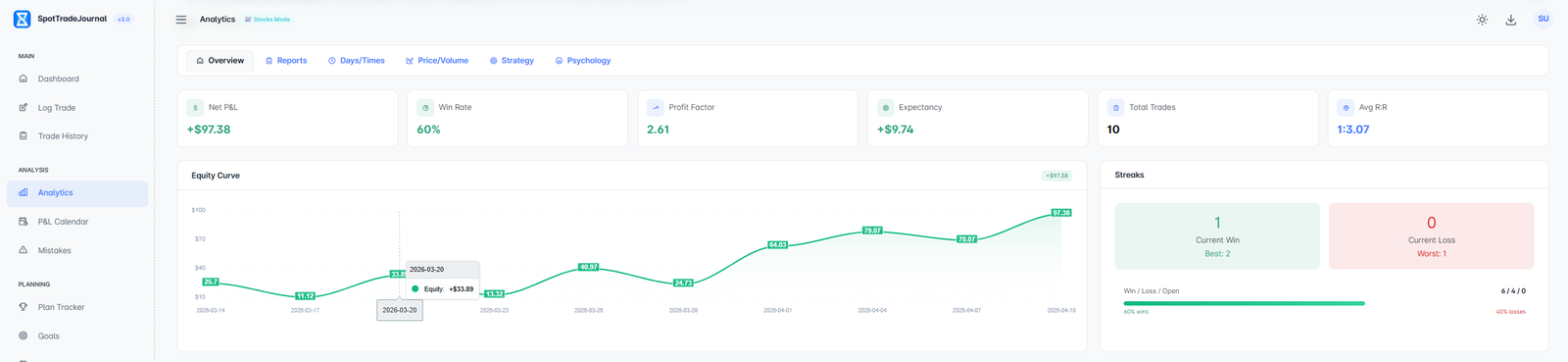
If you use SpotTradeJournal, you don't need to calculate this by hand. Your profit factor is calculated automatically on your Analytics dashboard and updated in real time as you log trades.
What Is a Good Profit Factor?
Here's a practical guide to interpreting your profit factor number:
Important: Profit factor is more reliable with a larger sample of trades. A profit factor of 3.0 on 8 trades is meaningless. The same number on 200 trades is very meaningful. Always look at your profit factor alongside your trade count.
Profit Factor and Sample Size
This is the mistake most traders make when they first discover profit factor — they calculate it on 10 or 15 trades and think they've found a holy grail strategy. Here's a rough guide to how many trades you need before the number becomes statistically useful:
- Under 30 trades: Too small to draw any conclusions. You're likely just seeing variance.
- 30–100 trades: Starting to be meaningful, especially if the number is consistent over time.
- 100+ trades: A reliable picture of your actual edge. Monitor this quarterly.
- 300+ trades: High confidence. Your profit factor at this sample size is close to your true edge.
The Relationship Between Profit Factor, Win Rate, and R:R
These three metrics are mathematically linked. If you know two of them, you can derive the third. The relationship is:
This tells you something important: with a 50% win rate, you need a minimum 2:1 reward-to-risk ratio just to break even after fees. Many traders don't realise this and wonder why they're losing despite winning half their trades.
How to Improve Your Profit Factor
There are two levers: increase your wins, or reduce your losses. In practice, the most reliable improvements come from the loss side:
1. Cut losers faster
The biggest killer of profit factor is holding losing trades hoping they'll come back. Every time you do this, you're increasing your gross loss without a corresponding increase in your gross profit. Respecting your stop loss is the single most impactful thing most traders can do to improve their profit factor.
2. Let winners run
Exiting winners too early is equally destructive. If your average win is $120 but your average loss is $200, your profit factor will be below 1.0 even with a 70% win rate. Identify your tendency to exit early and work on it systematically.
3. Filter out low-quality setups
Tracking your profit factor by strategy type will often reveal that 80% of your losses come from 20% of your setups — usually the lower-conviction ones you took out of boredom or FOMO. Removing those trades from your plan can dramatically improve your overall profit factor.
4. Track it by emotion and time of day
SpotTradeJournal's analytics break down your profit factor by emotion tag and by day of week. Many traders discover their profit factor drops below 1.0 on specific days or when they're trading in a FOMO or anxious emotional state — insights that are impossible to see without proper data.
Profit Factor in SpotTradeJournal
Your profit factor is displayed prominently on the SpotTradeJournal dashboard alongside win rate, expectancy, and your largest gain/loss. It updates in real time as you log or import trades.
The Analytics section also shows your profit factor broken down by:
- Strategy — see which setups have the best edge
- Day of week — see if you perform differently on Mondays vs Fridays
- Time of day — identify your peak performance windows
- Emotion — see how your mindset affects your actual P&L ratio
If you haven't been tracking your profit factor, the fastest way to start is to import your recent trades and let the analytics do the work automatically.
Summary: Profit Factor Is Your Edge Score
Think of profit factor as the single number that summarises whether your trading approach actually has an edge. Win rate tells you how often you're right. Profit factor tells you whether being right is worth anything.
- Profit Factor = Gross Profit ÷ Gross Loss
- Above 1.0 = profitable; below 1.0 = losing money
- 1.5–2.5 is the range of most consistently profitable traders
- Needs 100+ trades to be statistically meaningful
- Improve it by cutting losers faster and letting winners run longer
Track it consistently, review it monthly, and use it alongside win rate and R:R to build a complete picture of your trading performance.